
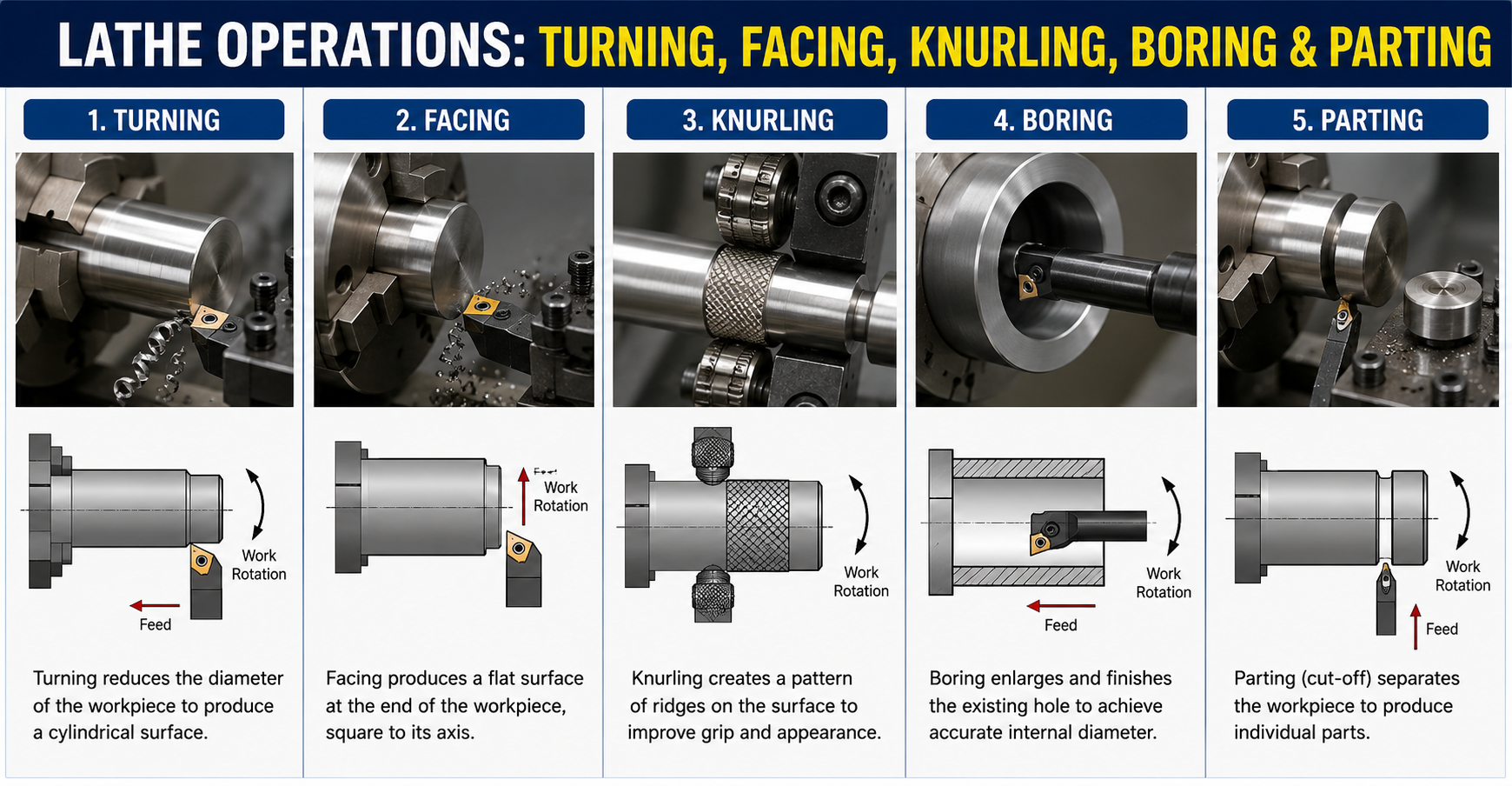
What Is Turning on a Lathe?
Turning is the process that you will carry out frequently when using a lathe machine. This is a process where the workpiece rotates while the cutting tool cuts the metal on its length while removing some of the metal. With time, the metal will reduce in diameter and will be left with a smooth cylindrical shape.
As an example, when you are given a thick bar of steel and told to reduce it into a small shaft, then you will use this method of reducing it to the desired dimension.
This process usually takes two stages to complete. The first stage involves rough turning where you remove metal quickly. This process leaves you with rough surfaces, but it is okay because it only helps you to get close to the dimensions. Finish turning is the second stage, and it removes the final thin layer.
It is always tempting to try and accomplish everything at once; but in reality, you will get a bad finish and wear out your tool faster than if you had taken lighter cuts. Cutting heavy first and light at the end will give you a better result with less effort on your part.
What Is Facing and Why Do You Start with It?
Facing is the process of cutting the face of a part in order to make it flat and squared. Your tool will move across the end of your workpiece, from its outer diameter to the center or vice versa. As soon as you complete the cut, the face of your part becomes even and square.
There is a logical reason why facing is often the first step in most machining operations. With a flat surface at the end, your workpiece will be easy to measure and drill because there is a solid surface for the tool and the gauge to lie against. Also, facing allows you to establish the exact length of your part.
What Are the Uses of Knurling?
Consider the grip that is provided by the screwdriver handle, thumb screw or a gym bar. The fine crisscross ridges present are known as knurling and are used for ensuring that the hand is able to grasp the component.
The operation of knurling is quite unlike other lathe operations since there is no cutting involved in it. Here the job involves pressing the hardened wheel into the rotating part to create an impression on it. Due to the considerable force needed here, the arrangement should be strong enough, along with keeping the speed low. The use of cutting oil would ensure that the pattern formed is sharp and clear.
Boring: What It Is and When It's Required
Boring is used when an enlargement or accurate enlargement of the hole is necessary. In this case, the hole should either be drilled or cast. The boring tool will be placed into the hole while the work is rotating and the hole is being cut to the proper size.
The boring tool must penetrate into the hole, which means that it should extend beyond the holder. However, if the tool extends too much, vibrations occur and affect the surface. Therefore, the shorter the tool is, the better, and light cuts should be taken.
In engine boring, bearing seats and bushes, the precision of the hole is especially important.
Parting and What Causes Tool Breakage
Parting, otherwise known as parting-off, separates the finished product from the bar. This process involves the use of a thin tool that is inserted perpendicular to the rotating workpiece.
Parting may seem simple, but it is the point at which tools usually break down. The blade is quite thin and may bend if too much pressure is exerted. A couple of tips include:
- Align the tool at the center height.
- Set the speed at a moderate level.
- Use a lot of coolant.
- Maintain proximity of the tool to the chuck.
What Other Work Can You Do With a Lathe?
A lot of work, such as drilling, reaming, grooving, taper turning and threading. The threading operation is very handy as you can make your own threads, bolts and nuts without having to use another machine.
How Can You Improve Lathe Performance?
Adjust speed according to the type of metal used. The harder the metal, the slower the speed, while softer metals can be turned faster.
- Keep your tools sharp: A blunt tool makes rough work and places strain on the lathe.
- Hold your work securely: Any movement will cause incorrect dimensions.
- Use coolant: Use coolant while working with steel.
- Check your measurements often: Do not wait until the last cut to check your measurements.
How to Choose the Right Lathe Machine?
The performance of a lathe machine depends upon its quality. If the bed is of low quality and the spindle is worn out, no matter how experienced a worker is, he would not be able to turn out an exact replica.
That is why, one should not take any risks while deciding the supplier for the lathe machine. A good lathe machine manufacturer has all the machinery checked before dispatching them from his manufacturing unit.
A reputable supplier always has spare parts available in his inventory to assist him at the time of trouble. In case you are purchasing a lathe machine from overseas, you may have a trustworthy exporter who will take care of packaging, documents, and shipping of the machine.
Prior to paying the price, inquire about the quality of the bed, spindle size, speed and guarantee period of the machine.
What Do You Need to Know About Lathe Operations?
These five operations include turning, facing, knurling, boring and parting and are responsible for the major functions of a lathe machine in everyday production. All of them have their unique roles to play.
Turning is about shaping the outer surface, facing means squaring up the end, knurling gives the required grip, boring means enlarging the inner surface of a hole while parting allows cutting off the ready product.
Once you get familiar with all five processes, you will be able to produce all kinds of parts on one single machine. But in addition to this, your success will depend on such aspects as sharp tools, appropriate speed, firm grip on the workpiece and good design of the machine.